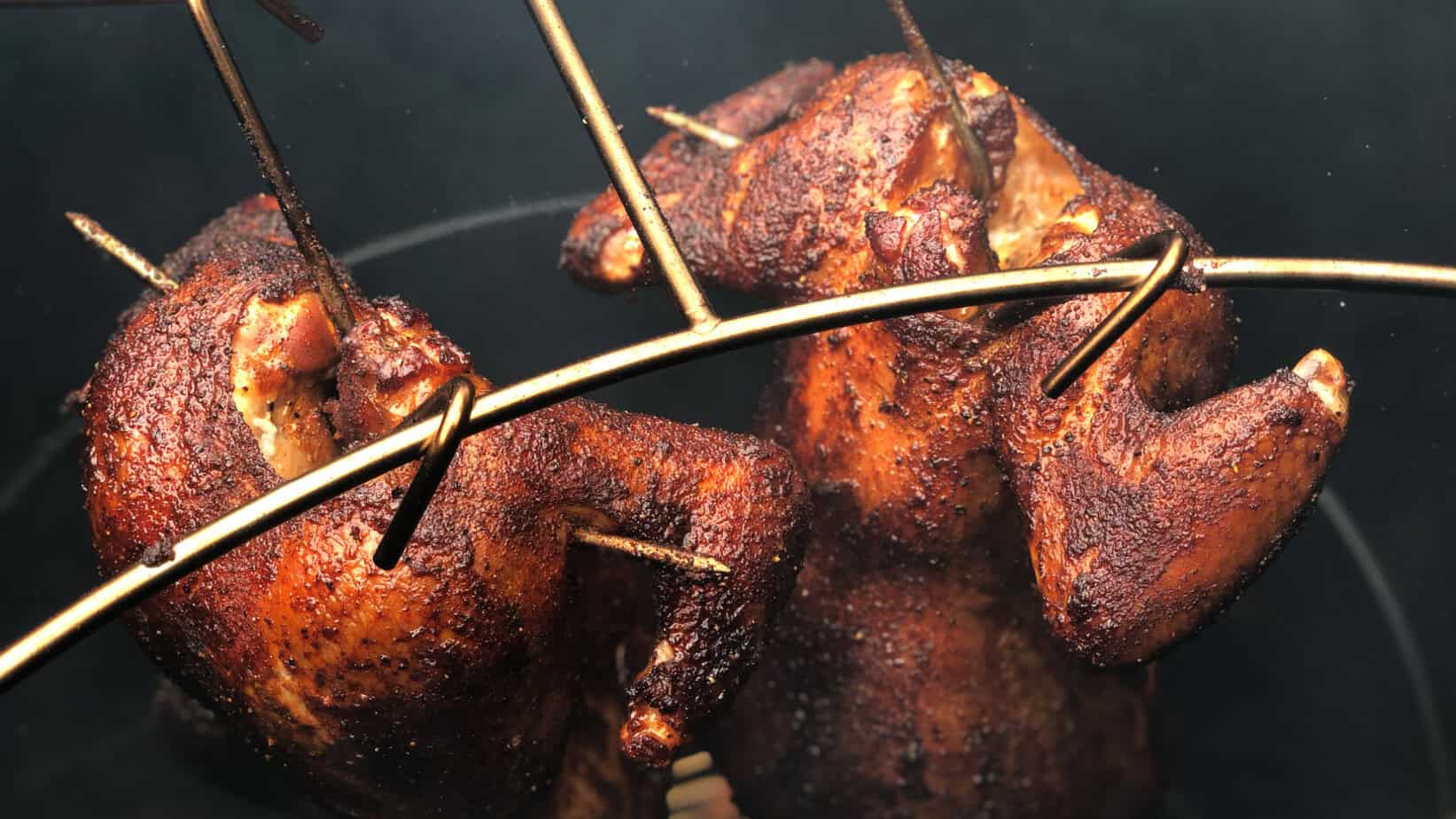
Best Temperature for Smoking Chicken
Smoking-Meat.com is supported by its readers. We may earn an affiliate commission at no extra cost to you if you buy through a link on this page.
One of the most common questions I get about smoking chicken is simple:
What temperature should I cook it at?
If my recipes and barbecue guides have helped you over the years, becoming a member is one of the best ways to support my family's business. As a thank you, you'll enjoy every recipe and article completely ad free for less than $2 a month.
Ad free • Instant access • Cancel anytime
Some folks insist that 225°F (107°C) is the only proper smoking temperature. Others cook chicken at 325°F (163°C) and never look back.
The truth is, both approaches can work. But they do not give you the same results, and once you understand what temperature is actually doing to the meat and the skin, you can stop guessing and start cooking on purpose.
What Happens at 225°F (107°C)
Cooking chicken at 225°F (107°C) gives you time in the smoke. That is important.
Especially on pellet smokers, where the smoke flavor is clean but lighter, that lower temperature window helps the meat absorb more smoke before the cook is finished.
That applies whether you are cooking a whole chicken, thighs, drumsticks, or wings. Smaller cuts still benefit from that early smoke time. If you start them too hot, they can be done before they ever really take on much smoke flavor.
The trade off is skin texture.
At 225°F (107°C), the fat under the skin does not always render fully before the chicken reaches a safe internal temperature. If you never increase the heat, you can end up with skin that is soft or rubbery instead of bite through.
If that has happened to you before, I go into detail about how to fix rubbery chicken skin on the smoker in a separate guide.
Low temperature builds flavor very well. It just is not ideal for finishing.
What Happens at 300 to 325°F (149 to 163°C)
When you cook chicken in the 300 to 325°F (149 to 163°C) range, the higher heat helps render the fat under the skin more effectively and dries the surface faster.
That improves skin texture significantly.
You are much more likely to get skin that bites cleanly with the meat instead of stretching away from it.
The downside is that the cook moves faster. If you start at this higher temperature from the beginning, especially with smaller pieces, you shorten your smoke window.
That is why simply saying “cook chicken hot” misses part of the picture.
The Best Overall Approach
For most backyard cooks, the best results come from using both temperature ranges.
Start the chicken at 225°F (107°C) for about 45 to 60 minutes so it can take on clean smoke flavor.
Then increase the heat to 300 to 325°F (149 to 163°C) and let it finish cooking at that higher temperature.
This works for whole birds and for parts. Even wings benefit from that early smoke time before you turn up the heat to tighten the skin.
You get flavor first. Then you get texture.
Internal Temperature and Food Safety
Now let’s talk about doneness.
The USDA recommends cooking poultry to an internal temperature of 165°F (74°C). That number is easy to remember and it is considered instantly safe.
But here is something most people do not realize.
Bacteria are killed by a combination of temperature and time. In other words, you do not have to hit 165°F (74°C) instantly for chicken to be safe. You can cook it to a slightly lower temperature and hold it there long enough to achieve the same level of safety.
For example, chicken that reaches 150 to 155°F (66 to 68°C) and rests for a few minutes can be just as safe as chicken that hits 165°F (74°C).
That said, you need to use a reliable thermometer and be confident in what you are doing. If you are unsure, 165°F (74°C) is still the simple, safe standard.
Dark meat like thighs and drumsticks can also be taken higher, into the 170 to 175°F (77 to 79°C) range, and often become more tender there.
The key is this:
Cook by internal temperature, not by time.
Time is just an estimate. Temperature tells you when it is done.
Is There a Temperature That Is Too Low?
Cooking chicken much below 225°F (107°C) usually does not help you. It extends cook time without adding meaningful benefits and can increase the chances of rubbery skin.
Chicken is not brisket. It does not need ultra low temperatures for hours and hours.
Moderate heat with a planned finish works better.
The Simple Process
If you want consistent results with good smoke flavor and good skin texture, here is a simple process to follow:
- Dry the skin before cooking.
- Start at 225°F (107°C) to build smoke flavor.
- Raise the heat to 300 to 325°F (149 to 163°C) to finish.
- Cook until the internal temperature reaches your target, at least 165°F (74°C) or lower if you understand and apply proper time and temperature safety.
Once you understand how temperature affects both flavor and texture, the decision becomes straightforward and your results become much more consistent.
Frequently Asked Questions
Should I smoke chicken at 225°F (107°C) or 325°F (163°C)?
Use both. Start at 225°F (107°C) to build smoke flavor, then increase to 300 to 325°F (149 to 163°C) to improve skin texture and finish the cook.
Is 165°F (74°C) the only safe temperature for chicken?
165°F (74°C) is the USDA recommendation and is instantly safe. Chicken can also be safely cooked to slightly lower temperatures if it is held there long enough, but you must use a reliable thermometer and understand the time and temperature relationship.
Can I smoke chicken at 250°F (121°C)?
Yes. 250°F (121°C) works as a middle ground and still builds smoke flavor. You may still benefit from finishing hotter for better skin texture.
Why does my chicken skin get rubbery at lower temperatures?
Lower temperatures do not always render the fat under the skin before the meat is done. Increasing the heat toward the end of the cook helps improve texture.
Don’t Lose This Article
Enter your email and I’ll send a link to this article straight to your inbox so you can read it anytime.