How to Remove the Membrane From Pork Ribs

Smoking-Meat.com is supported by its readers. We may earn an affiliate commission at no extra cost to you if you buy through a link on this page.
The membrane on the bone side of pork ribs can be one of the more aggravating parts of getting a rack ready, especially when it refuses to come off in the neat sheet you have seen someone else pull away. I generally remove it because I prefer the way the ribs eat without that tough layer, but there is no need to let a stubborn piece turn the whole preparation into a wrestling match.
$19/year
Less than $1.60 a month, billed annually.
Renews yearly until canceled.
Already a member? Log In
This applies to baby back ribs, spare ribs and St. Louis style ribs, and the process is much the same for all three. You need something blunt to help lift the membrane, a paper towel for grip and a little patience if the first attempt only gets you a small strip.
Find the Membrane on the Bone Side
Lay the rack with the curved, exposed bones facing up and look for a thin, shiny layer stretched across them. It can look a little like plastic film, although its appearance changes with the cut and how the meat has been handled.
You are looking for a layer that lifts away from the bones, rather than trying to remove every pale strip of connective tissue you can see. If there is a loose meat flap covering part of the rack, trim that away first so you can see what you are working on, using the spare rib trimming instructions if needed.
Lift a Small Section Over a Bone
Slide the rounded end of a butter knife or spoon beneath the membrane over one of the bones near the end of the rack, then gently lift until you have a loose edge. Working over a bone gives you something firm underneath and helps keep you from digging into the meat between the bones.
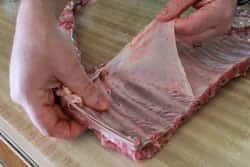
Once you have enough to grab, put the knife aside rather than pulling the membrane with a sharp blade pointed toward your hand. If that first location does not work, try another bone or start closer to the middle and work in both directions.
Use a Paper Towel for Grip
Pinch the loose edge with a dry paper towel and pull it steadily back across the rack, staying fairly close to the surface instead of yanking straight upward. The towel makes a big difference when the membrane is too slippery to hold with bare fingers.
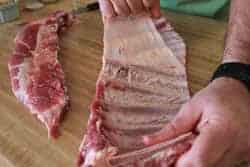
Sometimes the whole layer comes off together, and sometimes it tears after a few inches. Either result gets you closer, so lift another edge and continue rather than assuming you did something wrong because the rack did not cooperate on the first pull.
What If You Cannot Find It?
Some ribs have the membrane removed before packaging, and that is worth considering before you spend ten minutes scraping at a rack that does not have one. Check several places over the bones for a distinct layer you can lift, and look for an exposed surface rather than a continuous tight sheet.
If nothing will separate after a reasonable attempt, stop digging into the meat. You can cook the rack and evaluate how it eats, then pay attention to the preparation on the next package rather than trying to strip away tissue that belongs with the meat.
Can You Leave the Membrane On?
You can smoke ribs with it in place, and leaving it on will not automatically ruin the rack. I prefer removing it for texture, but I have also cooked ribs without removing it, so I would not tell you to give up on dinner over a stubborn membrane.
If you decide to score it instead, make shallow cuts through the membrane without cutting deeply into the meat, understanding that scoring breaks up the sheet rather than making it disappear. Neither leaving it on nor removing it replaces the need to cook the ribs until tender, and I would not count on it as a seal that holds all the moisture inside.
What Comes Next?
Once the membrane is out of the way, pat the rack as needed, apply your seasoning and get it ready for the smoker. My rib seasoning guide covers binders, rub and seasoning ahead, while the complete pork rib guide takes you through the cook from beginning to end.
Don’t Lose This Article
Enter your email and I’ll send a link to this article straight to your inbox so you can read it anytime.