

How to Use the Minion Method on a Charcoal Smoker

I may earn a commission if you buy through links on this page, at no extra cost to you.
The Minion method is a way of setting up charcoal so your smoker can maintain cooking heat for several hours without needing frequent additions of fuel. Instead of lighting the entire load at once, you start with mostly unlit charcoal and add a smaller amount of burning charcoal, which gradually lights the surrounding fuel as the cook progresses.
$19/year
Less than $1.60 a month, billed annually.
Renews yearly until canceled.
Already a member? Log In
This is especially useful when you’re cooking pork butt, brisket, ribs or anything else that needs a longer cooking time, and you’d rather spend that time doing something besides lighting another batch of charcoal.
I originally wrote this page using my Weber Smokey Mountain, and the photos still show that setup. I’ve since expanded the instructions to explain how the Minion method works in other suitable charcoal smokers as well, although the amount of fuel, lighting arrangement and vent settings will depend on the cooker you’re using.
What Is the Minion Method?
Named after Jim Minion, this method gives the smoker a supply of fuel without having all of it burning at once.
The unlit charcoal serves as the reserve, while the smaller portion of burning charcoal establishes the fire. As that charcoal burns, it gradually ignites nearby pieces and keeps the cooking heat going.
The vents control how much air reaches the fire, which affects how actively the charcoal burns and how quickly it uses the remaining fuel.
That distinction is important because a basket full of charcoal doesn’t automatically mean a high cooking temperature. A smaller fire working through that basket can maintain low cooking heat, provided the smoker allows you to control the airflow.
Which Smokers Can Use the Minion Method?
The Minion method works well in many charcoal smokers that have a charcoal ring or basket, adjustable air inlets and a lid or door that closes reasonably well.
Bullet smokers, charcoal cabinet smokers and some drum smokers are good examples, although their starting procedures can differ. A cooker designed to light from one corner of the basket may need a different arrangement from one that starts with hot charcoal distributed over the top.
A charcoal grill can also use a version of this setup, provided the fuel is contained away from the food so you maintain an indirect cooking area.
Follow any lighting procedure supplied with your smoker, especially when it specifies the starting quantity of charcoal or where the fire should begin. The Minion method describes the general approach, but it doesn’t make every charcoal cooker operate the same way.
What You’ll Need
You’ll need a suitable charcoal smoker, enough charcoal for the expected cooking time, a chimney starter, heat-resistant gloves and a thermometer that measures the temperature near the food.
Long tongs are useful for positioning fuel and smoking wood, and you’ll want a few dry wood chunks if you’re adding wood smoke to the cook.
Before starting, make sure the charcoal grate and basket are installed correctly and that the cooker is positioned outdoors on a stable surface with the clearances required by its manufacturer.
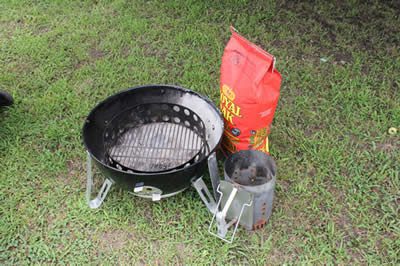
Lump Charcoal or Briquettes?
Both can work when your smoker allows them.
I’ve used lump charcoal for the Minion method for years, and that’s what you’ll see in these photos. The irregular shapes require a little attention when loading the basket so there aren’t large gaps that prevent the fire from spreading through the fuel.
Briquettes have a more uniform size and shape, which makes it easier to repeat the same arrangement and starting quantity from one cook to the next.
Use plain cooking charcoal rather than instant-light charcoal or charcoal treated with lighter fluid, since fresh fuel will be igniting throughout the cook.
While you’re learning, use the same charcoal for a few cooks so you can get a feel for how the smoker behaves before changing another part of the setup.
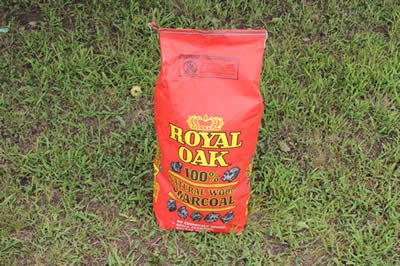
The comparison of lump charcoal vs briquettes covers the handling differences in more detail. For cooker-specific setup, use the charcoal smoker guide, drum smoker guide or kettle guide, depending on what you’re cooking with.
The snake method is a different arrangement for suitable grills, while two-zone grilling explains how to separate the food from direct heat.
How to Set Up the Minion Method
Load the Unlit Charcoal
Start with a cool smoker and remove leftover ash from the previous cook. Check that the air openings are clear and that there’s room beneath the charcoal grate for ash to fall without blocking the fire’s air supply.
Load the charcoal ring or basket with enough unlit fuel for the cooking time you expect, staying within the cooker’s recommended capacity.
For a long cook, that may mean filling the basket. A shorter cook may need less, but don’t confuse the total amount loaded with the amount you need to light.
Arrange the pieces so neighboring charcoal makes contact, without filling the spaces underneath and between them with charcoal dust and tiny fragments.
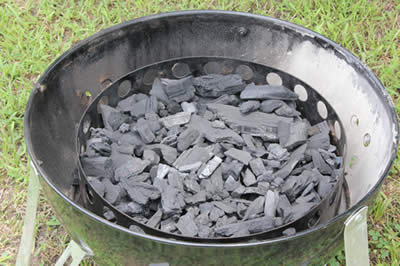
Plan Where the Smoking Wood Will Go
You can position dry wood chunks among the unlit charcoal before lighting, or add them on top after placing the burning charcoal.
Keep some close enough to the starting fire to produce smoke early in the cook, with other pieces where the spreading fire can reach them later.
Start with a modest amount of wood rather than filling every available space. The right amount depends on the cooker, cooking time and how much smoke flavor you enjoy.
The original cook shown here used cherry splits, but appropriately sized chunks are convenient for most charcoal baskets and easier to position without crowding the fuel.
Pecan is one of my favorites, although oak, hickory, apple and cherry are all useful options. My Smoking Wood Guideexplains more about choosing your wood.
Light the Starting Charcoal
Use a chimney starter to light a smaller portion of charcoal separately from the main fuel bed.
The starting amount needs to match the cooker and the temperature you want to maintain. A large, uninsulated smoker may need more burning fuel to warm up than a smaller or well-insulated cooker.
If your smoker supplies a starting quantity for low and slow cooking, use that as your reference. Otherwise, begin with a modest portion rather than assuming you need a full chimney, then adjust based on how the smoker responds.
In the original photos, I used a chimney approximately two-thirds full of lump charcoal for that particular Weber setup. That shows what I used for that cook rather than a required quantity for every smoker.
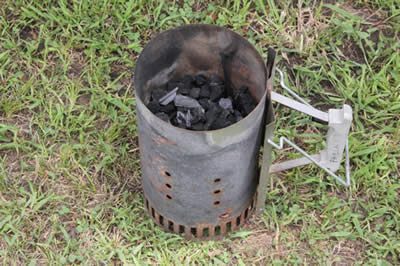
Light the chimney according to its instructions, using a suitable starter and placing it on an approved heat-resistant surface.
The original photo below shows the chimney on my gas grill’s side burner. Use that arrangement only if both pieces of equipment are approved for it; a chimney on the grill’s charcoal grate with an appropriate fire starter is a straightforward alternative where permitted.
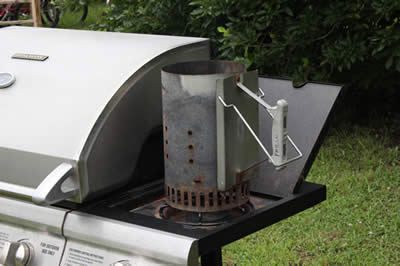
Allow the starting charcoal to become well lit before transferring it. Look at the condition of the charcoal rather than expecting every batch to be ready in the same number of minutes.
For more detailed instructions, see my Charcoal Chimney Starter Guide.
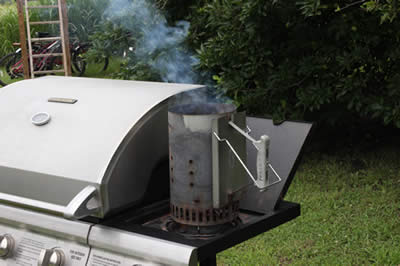
Add the Lit Charcoal to the Fuel Bed
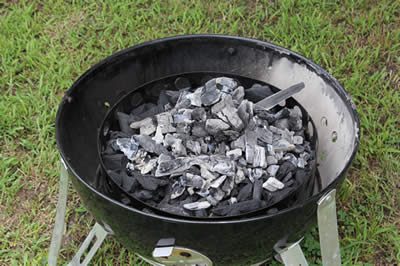
Wearing heat-resistant gloves, carefully transfer the lit charcoal onto the unlit fuel.
A common arrangement is a small pile on top or in a shallow depression in the fuel bed. Some charcoal cabinets use an end or corner starting point, so follow that arrangement when specified.
Make sure the burning charcoal touches the fuel that needs to light next, while leaving space for air to reach the fire.
In the photo, I poured the lit charcoal over the top and spread it slightly. You don’t need to distribute hot coals across every part of the basket, since that can establish a larger fire than you intended.
Assemble the Smoker for Cooking
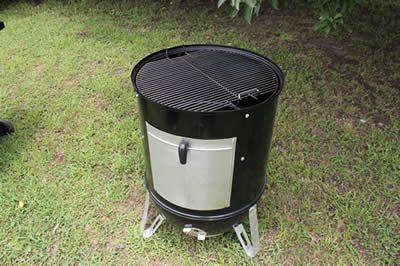
Install the cooking grates, heat deflector, drip pan and other components required for your smoker’s cooking setup.
If the cooker uses a water pan, prepare it according to its instructions. The Minion method itself doesn’t require water, and a drum or cabinet smoker shouldn’t be given the same water-pan setup simply because the Weber in these photos uses one.
For a water smoker, keeping the pan setup consistent helps you learn the cooker. A filled pan and an empty pan can produce different temperature behavior.
Position a thermometer probe near where the food will cook, without allowing it to touch the meat or metal grate.
Bring the Smoker Up to Temperature
Close the cooking chamber and follow the startup vent settings recommended for your cooker.
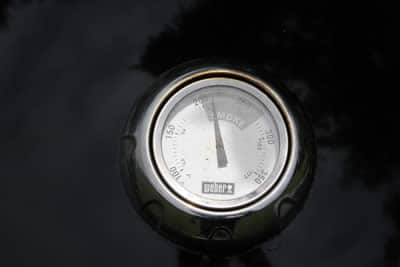
For many low and slow recipes, you’ll be aiming around 225°F to 250°F (107°C to 121°C), although the recipe may call for something different.
Watch the grate-level thermometer and begin reducing the intake airflow as the smoker approaches the target. It’s generally easier to slow the temperature rise before it overshoots than to cool down a cooker with too much charcoal already burning.
Keep an adequate exhaust path through the smoker, and make small adjustments with time between them so you can see the result.
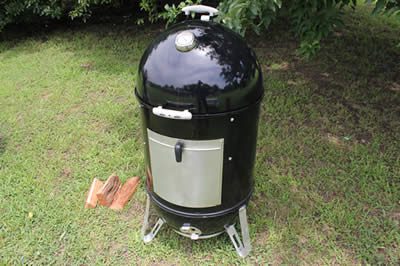
Once the temperature is reasonably steady and the heavy startup smoke has cleared, add the food.
The temperature may drop when you open the cooker and put cold meat inside, so give it time to recover before adding fuel or opening the vents farther.
Maintaining the Fire During the Cook
The Minion method reduces how often you need to add fuel, but you still need to monitor the cooker.
Watch the temperature trend rather than trying to correct every small movement. If the smoker is holding within a reasonable range for the recipe, leave it alone.
When the temperature starts falling, check whether the fire is running short of fuel, ash is restricting airflow or the intake needs a small adjustment. Those problems can look similar on the thermometer but need different corrections.
If ash is interfering with the fire, gently address it through the intended access opening with an appropriate tool, taking care not to send ash toward the food.
Check the water level periodically if you’re cooking with water, and refill carefully before the pan runs dry. If additional charcoal is needed, add it through the cooker’s intended fuel access.
My Smoker Temperature Control Guide explains these adjustments in more detail.
How Long Will the Minion Method Burn?
Burn time depends on the smoker’s fuel capacity, insulation, cooking temperature, airflow and charcoal, along with the weather.
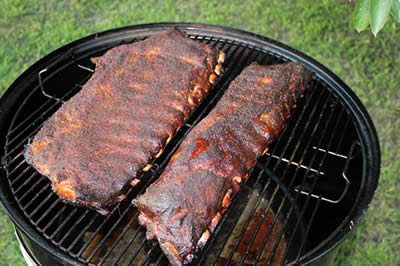
For the original rib cook shown here, the Weber held around 225°F (107°C) for approximately seven hours, with fuel still remaining when the ribs were ready.
That gives you an example of what the method can accomplish, but your cooker may need more fuel sooner or run considerably longer.
Make a note of how much charcoal you loaded, how much you lit and when the temperature began to decline. After a few cooks, those details will give you a much better starting point than someone else’s longest reported burn.
Troubleshooting the Minion Method
The Smoker Gets Too Hot
Check for too much lit charcoal at startup, excessive intake airflow or a lid or door that isn’t seated properly.
Reduce the intake gradually and allow time for the smoker to respond. If the problem repeats, start the next cook with less lit charcoal.
Repeatedly opening the cooking chamber to release heat can feed the fire additional oxygen and make it harder to settle.
The Smoker Won’t Reach Temperature
Check that the starter charcoal was burning well, the air openings are clear and the burning fuel makes contact with the charcoal around it.
Cold weather, a large cold water pan and a heavy load of food can also slow the temperature rise.
If the fire genuinely needs more heat, a small addition of lit charcoal can help, but give each adjustment time to work before making another.
The Fire Fades With Charcoal Still in the Basket
Look for ash buildup, restricted airflow or gaps between pieces of fuel.
Carefully restore contact or clear the restriction through the intended access opening. Don’t lift apart or move a hot smoker while it contains burning charcoal, food or hot water.
The Food Tastes Too Smoky
Check how much smoking wood you used and whether the fire had adequate airflow.
A long-running charcoal setup doesn’t need a large amount of wood throughout the basket, and adding more wood won’t improve a fire that’s struggling to burn.
Try less wood on the next cook and keep a clear path for smoke to leave the cooker.
Finishing the Cook
Follow your smoker’s shutdown instructions once the food is ready.
On many conventional charcoal smokers, closing the vents and leaving the lid or door shut helps extinguish the remaining fuel. Keep the smoker outdoors until the charcoal and ash are completely cold.
Remove the cooled ash, save suitable dry, unburned charcoal for another cook and clean the smoker as needed. My Smoker Cleaning Guide covers that process.
Once you find a starting fuel load and airflow setup that work well, repeat them a few times. Getting familiar with your own cooker is what makes the Minion method dependable.
The water-pan guide explains the pan setup when your cooker uses one, and the smoker shutdown guide covers extinguishing the remaining fuel. You’ll find the rest of the cooker and setup guides in my Ultimate Guide to Smokers.
Don’t Lose This Article
Enter your email and I’ll send a link to this article straight to your inbox so you can read it anytime.
Join the Smoking Meat Community
Have a question about this technique or want help with your next cook?
Join the conversation with other backyard pitmasters.
From my backyard to yours
Jeff’s Handcrafted
Seasoning and Sauce
The rubs and sauces I use in my own backyard
and throughout these recipes.
CLASSIC BARBECUE
Original BBQ Sauce
Rich tomato flavor, balanced sweetness and a gentle kick.
$8.99per bottle
Shop Now
THE SIGNATURE BLEND
Original Rub
Sweet, savory and a touch of heat for your next cook.
$8.99per bottle
Shop Now
BOLD & PEPPERY
Texas Style Rub
Pepper forward flavor for brisket, steaks and more.
$8.99per bottle
Shop Now
MUSTARD BBQ SAUCE
Golden Driller
Smooth mustard tang with just the right sweetness.
$8.99per bottle
Shop NowFind your next favorite at Thin Blue Foods

Okay, so I have a 22.5″ smoker. Are the instructions the same or does it change?
Same
Jeff, I used the minion method on labor day for ribs and chicken using the WSM. I used the chimney starter, however I used the weber starter cubes. I also placed the lite charcoal in the middle to creep inside out and the hickory chunks (3) around. I have a couple of ?’s. Do use water? Have you heard any problems with the cubes? I did not think it got hot enough so I stoked a few times. The meats were blackened with what appears to have been charcoal dust. Do you suggest stoking? Most of the meats were destroyed. There were however some tasty morsels and they were very tender. Thanks in advance!
I see in the picture, you appear to be adding split logs. Do you use split longs in a WSM? Or chucks of wood? Pros vs cons of using splits?
I have used this method a few times and the temps STILL get up to over 300. What am I doing wrong?
Terry –
Probably too much air flow. More air = higher temps. Chef Richard McPeak teaches that once you’ve got your fire going, to have the top vent only 1/4 to 1/2 open and 2 of the bottom 3 vents completely closed and the third wide open. I found that I sometimes have to open 1 of the closed vents about 1/3rd to get up to 225. Also make sure your water pan is full. This not only adds moisture to the cook, but acts as a heat sink.
One other thing he teaches is to make a “charcoal sandwich” by adding a thin layer of unlit charcoal over your lit coals at the start. The theory is, in part, that igniting the unlit coals absorbs some of the heat and keeps a steadier, lower temperature. It’s worked well with me!!
How much smoke should I notice in the smoke chamber , a light fog or a medium fog or more ?
Is it going to be ter to smoke a turkey on a bottom or top grill of my smoker?
should ribs go on room temp or cold?i heard if they go on cold they take longer to cook but create a better smoke ring…this true or no…im new to this…help