


How to Trim a Brisket and Separate the Point from the Flat (Step by Step Guide)
Smoking-Meat.com is supported by its readers. We may earn an affiliate commission at no extra cost to you if you buy through a link on this page.
Trimming a brisket is not about making it look pretty on the cutting board. It is about helping it cook evenly so you do not end up with one part dry and another part still tough.
A properly trimmed brisket cooks more consistently, develops better bark, and is easier to manage on the smoker. When the thickness is more even and the hard fat is removed, the heat and smoke can move around it the way they should.
If my recipes and barbecue guides have helped you over the years, becoming a member is one of the best ways to support my family's business. As a thank you, you'll enjoy every recipe and article completely ad free for less than $2 a month.
Ad free • Instant access • Cancel anytime
Want the Complete Brisket System?
The Brisket Field Manual walks you step by step through temperature, stall management, tenderness testing, and a repeatable cook timeline.
Free printable PDF. Instant access.
If you are working through the full brisket process, this step fits right into the complete guide from choosing the brisket all the way to slicing it.
What Trimming Actually Accomplishes
When you buy a whole packer brisket, it usually comes with thick heavy fat, hard waxy sections, and thin edges that will burn long before the center is done.
Trimming helps prevent burnt edges, allows smoke to reach more of the surface, improves bark development, and gives you better control over how the fat renders during the cook.
This is not about removing all the fat. Fat is important. What we are doing is removing the wrong fat, especially the hard stuff that will never render properly no matter how long you cook it.
Tools You Need
You really do not need anything fancy.
All you need is a sharp knife, a large cutting board, and a few paper towels to keep things from sliding around.
Sharpness matters more than the type of knife. A dull knife will make trimming frustrating and sloppy.
Why You Might Separate the Brisket Point from the Flat
Before we start cutting, let’s talk about separating the brisket.
A whole packer brisket has two muscles. The flat is the long, leaner section. The point is the thicker, fattier section that sits on top of one end.
The flat is usually done once it reaches about 200°F (93°C) internally or so.
The point has more fat inside and often needs to go a little longer so that fat can fully render. Sometimes that means going past 200°F (93°C).
If you plan to make burnt ends, separating the point makes that easy since you can cube it up and return it to the smoker without overcooking the flat.
It is completely optional, but it does give you more control.
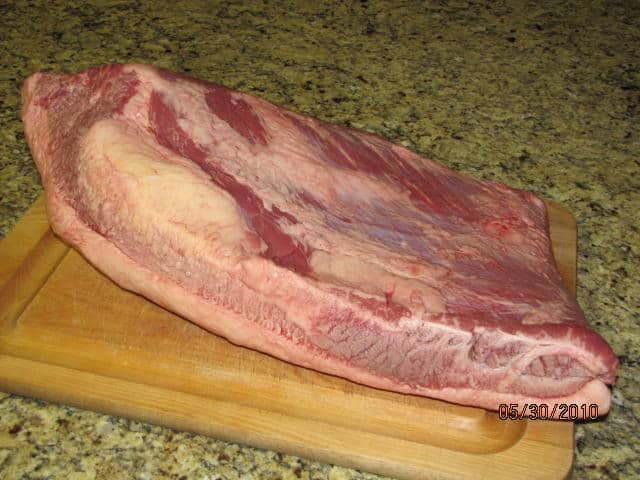
Start With a Whole Packer Brisket
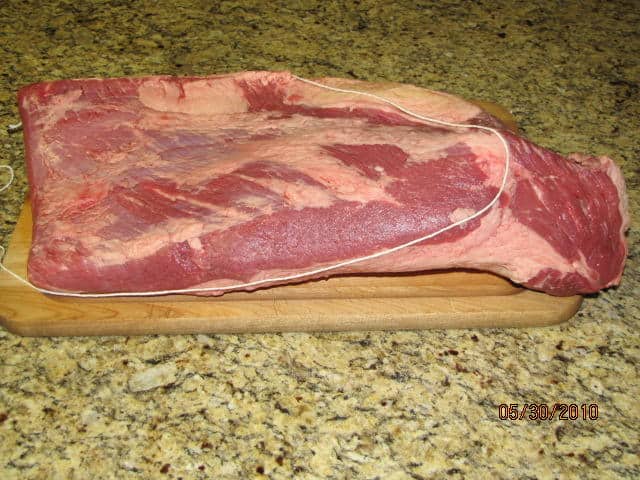
This is a normal full packer brisket weighing around 16 pounds.
Identify the Point and the Flat
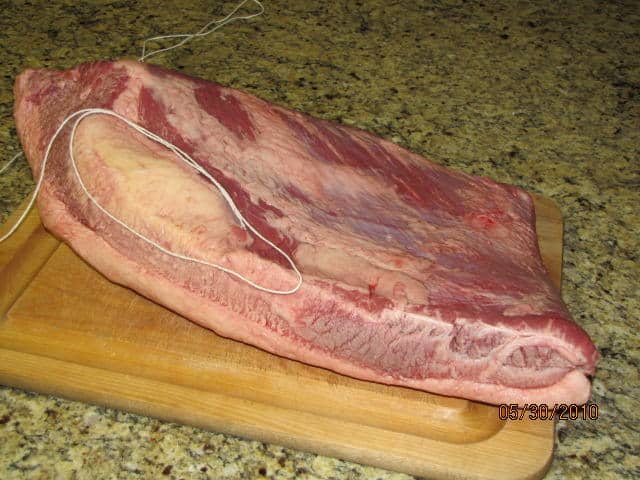
One way to clearly see where the muscles meet is to outline the area. My friend Pete from SMF demonstrated this using a piece of butcher twine, which makes it easy to visualize before you ever make a cut.
Here the string outlines what some folks call the “corn,” which is that large hard chunk of fat on the side that needs to be removed.
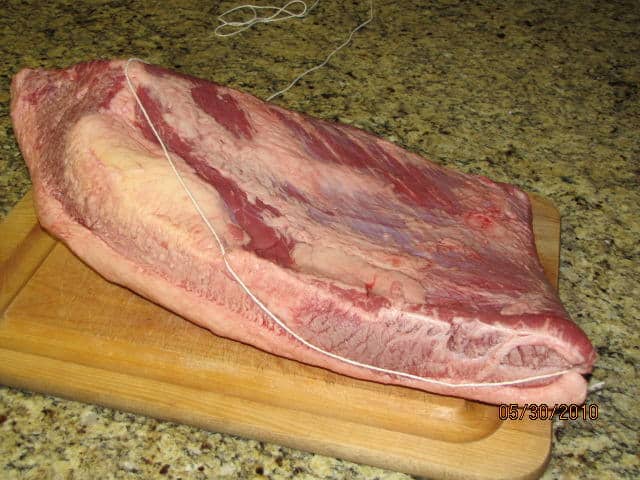
The string also shows where the point and the flat meet. The flat is on one side of that seam and the point is the thicker fatty section on the other.
Flip It Over and Find the Seam
If you flip the brisket over, you will notice a natural seam of fat that runs between the two muscles. That seam is your guide if you decide to separate them.
You do not have to guess. The fat line tells you exactly where to cut.
Remove the Corn
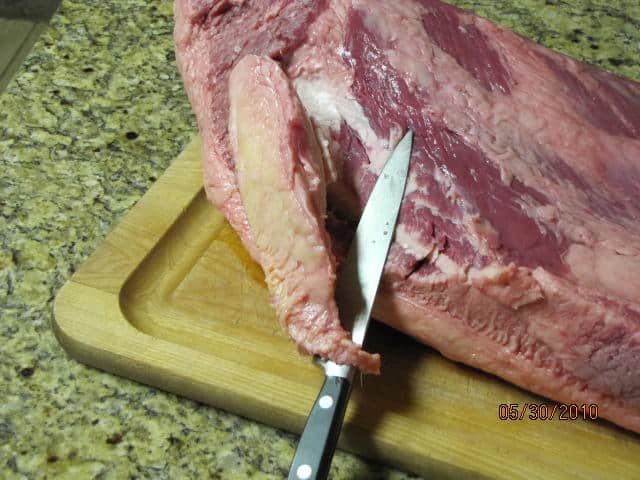
I like to remove that large hard chunk of fat, sometimes called the corn, right away. It will not render and it just gets in the way.
Trim it off cleanly and set it aside.
How to Separate the Brisket Point from the Flat
Now that the hard outer fat is gone, you can clearly see the seam outlined earlier.
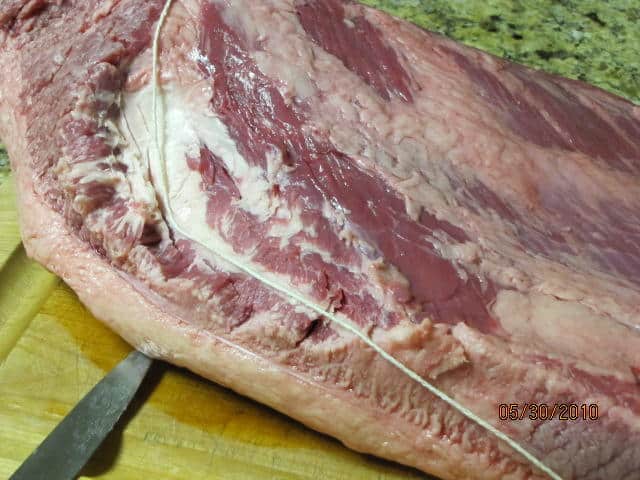
Start cutting along that seam of fat from the top down. Let your knife glide through the fat instead of forcing it through red meat.
If you notice you are cutting into the red meat, just adjust your knife slightly up or down until you are back inside the fat seam. The fat will guide you if you pay attention to it.
As you work your way down, the two muscles will begin to separate naturally.
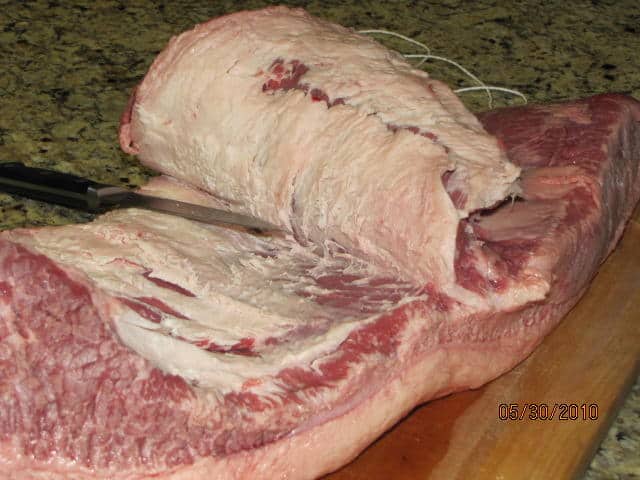
It actually gets easier as you go because the separation becomes more obvious.
Keep following the fat line and before long the flat and the point will be completely separated.
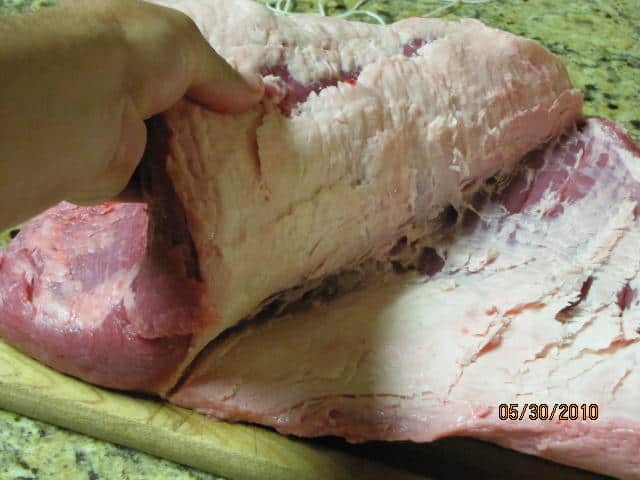
Here is what a fully separated brisket looks like.
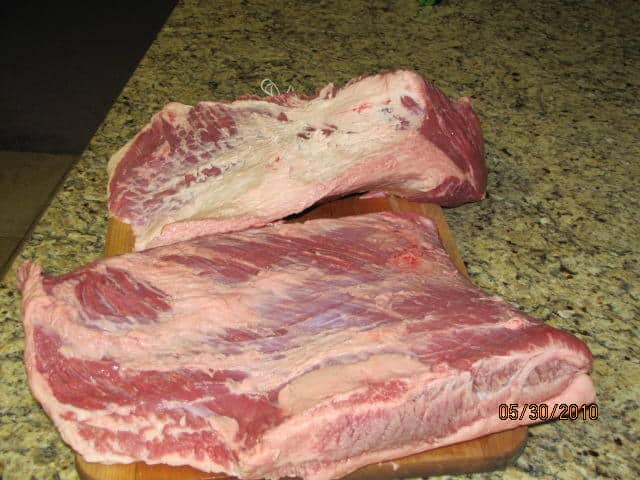
Trimming the Point
Once separated, you can trim additional surface fat from the point if you like.
The point already has plenty of internal marbling, so removing excess outer fat is mostly a preference choice.
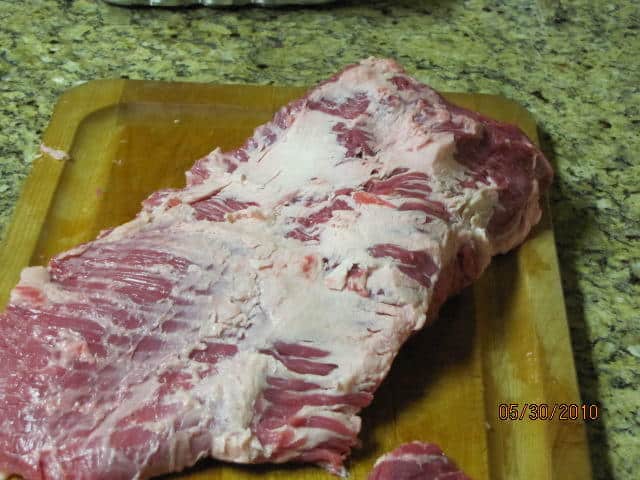
Trim the Fat Cap on the Flat
Now let’s talk about trimming the fat cap.
Your goal is not to remove all of it. You want to leave about a quarter inch of fat or so across the surface. It does not have to be exact. Close is fine.
Remove thick heavy deposits and smooth the surface so the layer is more even from end to end.
Very thick fat will not render well and can block seasoning and smoke.
Remove Hard and Waxy Fat
As you trim, feel for dense, rubbery fat that looks bright white and shiny. That fat will not break down during the cook.
Remove it completely, especially any hard fat left in the seam area.
Shape the Edges
Thin flaps and sharp corners will dry out or burn before the center finishes cooking.
Round off thin edges and remove loose pieces so the brisket has a smooth shape that allows heat and smoke to move around it evenly.
Final Inspection
Before you stop trimming, take a step back and look at the brisket as a whole.
You want:
An even fat layer
No hard fat remaining
No thin dangling pieces
A consistent overall shape
Once it looks balanced, you are ready to season and move on to the smoker.
Common Trimming Mistakes
Leaving too much fat and assuming it will melt away is a common mistake.
Removing all the fat is another.
Ignoring the hard fat in the seam area usually shows up later when slicing.
Trimming is not about perfection. It is about understanding how that brisket is going to cook and setting it up for success.
Related Articles
Don’t Lose This Article
Enter your email and I’ll send a link to this article straight to your inbox so you can read it anytime.
Join the Smoking Meat Community
Have a question about this technique or want help with your next cook?
Join the conversation with other backyard pitmasters.

Excellent article on preparing a brisket for successful smoking.
Would be nice to get a video. Thanks for this though.
Very Informative! I’m constantly striving to create the “perfect” brisket and your continual articles are helping me to do just that! Thanks Jeff!
This couldn’t have come at a better time. Just bought a brisket at Reasors, as they were on sale $2.98/pound. Going to try them next week